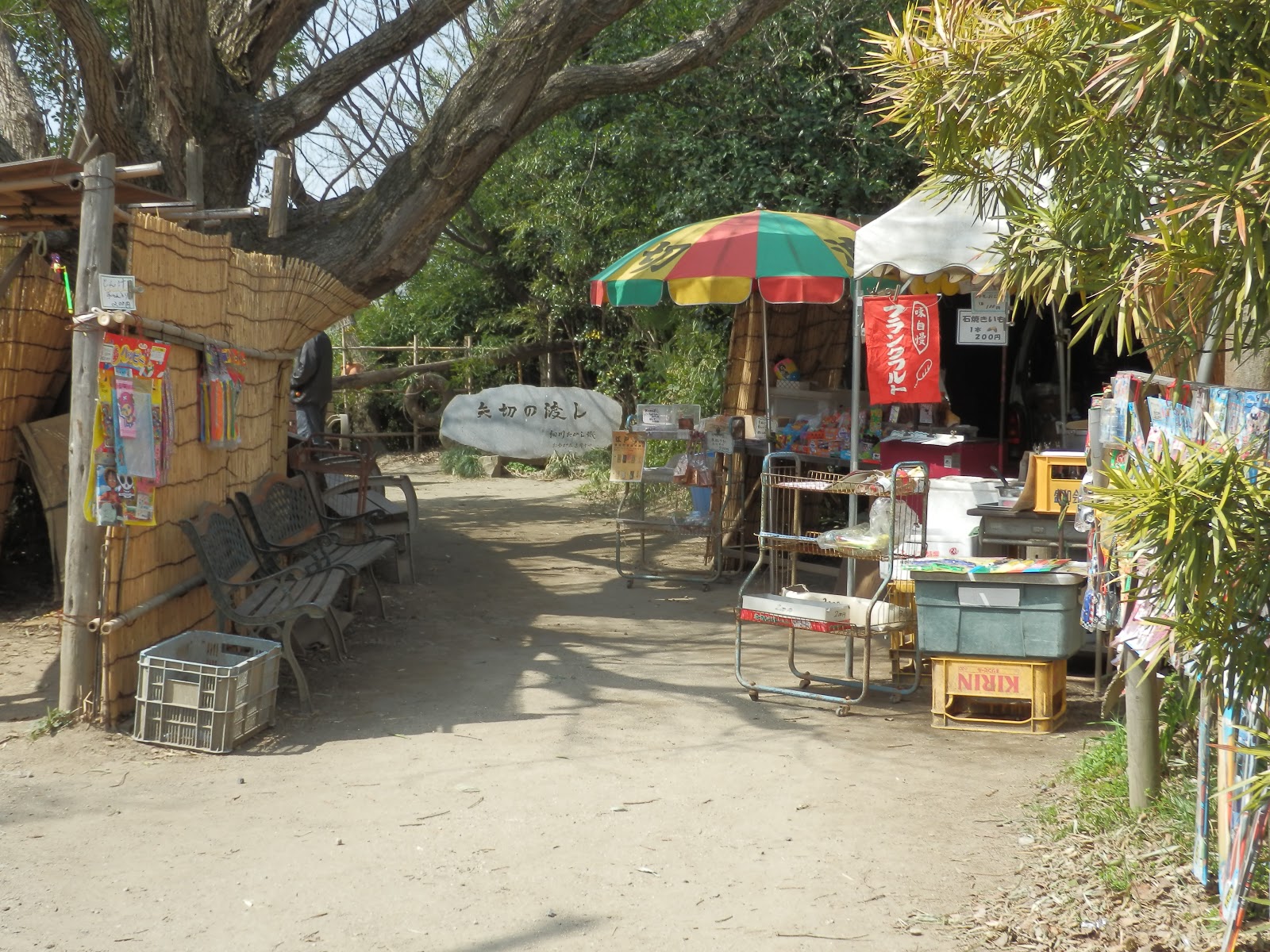
'Yagiri-no-Watashi' (Yagiri Ferry Crossing) is a hidden tourist spot in northeastern Tokyo where Japanese people gather for a a little ferryboat crossing from Tokyo to Chiba prefecture in Edo River.
It was an important transportation for local people which has 400 years of history and it is now only used for sightseeing.
There was no tourist information desk or ticket counter near the pier but the hand written signs tell you everything what you need to know - pay 200 yen for adult and 100 yen for child to the boatman, don't dive, don't smoke on a ferryboat.
There were no foreign tourists and hardly any young Japanese people when we were there at the pier.
It is a poplar tourist attraction for relatively older generation who grew up with a particular Japanese novel, movie and song.
The story of famous novel, 'Nogiku no Haka' (Grave of Wild Chrysanthemum) is based in this area; the ferryboat often appears in the most beloved series of Japanese movie, 'Otoko wa Tsurai yo'(It's Tough Being a Man); and the popularity peaked in 1980s when a song, 'Yagiri-no-watashi' has become the Japanese number one hit song in the era.
Maximum of 30 passengers squeeze in a little boat.
It is approximately 10 minutes journey to cross the river.
There is no tour guide on the boat and passengers only hear the gentle slap of the oar by the boatman in the tranquil water of Edo River.
There is no safety net at the pier. Children like its fragile look.
The sign of historic meaning of 'Yagiri-no-Watashi' stood at the river bank in Chiba prefecture side.
The above is a wharf in Chiba prefecture side.
It brings us back to memories of good old days.
A painting of 'Yagiri-no-watashi' in a temporary public toilet.
After a ferryboat ride, we strolled back to the main tourist area in Shibamata, Tokyo.
The working class neighbourhood of Shibamata is always lively with people with dozens of souvenir shops and eateries along the road leading to the temple, Taishakuten.
Yagiri Ferry Crossing is perhaps the only remaining human-powered boat in Tokyo and 'the Shibamata Taishakuten area and Yagiri Ferry Crossing have been selected by the Ministry of the Environment in their choice of ''100 Best Places of Delight Sounds in Japan''.'
It is truly worthwhile to see the untouched downtown Tokyo.
Y★
He is a Japanese comedian and an outstanding artist for the flip books.
Tekken created an emotional 3 minute flip animation titled 'Pendulum', 'Furiko' in Japanese, for the British rock band Muse last year.
The model of the 'Pendulum' is an average middle class Japanese family and the story describes ordinary days for ordinary Japanese people.
... the happiness, anger, sadness, forgiveness, regrets, praises, compassion, compromise, thankfulness ... all you could experience through the lifetime.
A three minute video with 1038-page flip book along with the swings of a pendulum reminds you something which may have been forgot.
The life in the 'Pendulum' is not irrelevant to you all in and outside Japan.
Y★
Kuma-mon (A black bear mascot from Kumamoto Prefecture; the picture from Kuma-mon official site: http://kumamon-official.jp, Japanese only)
On the day after the Valentine's Day, an article caught my eyes; "'Hikonyan' received the record high 228 chocolate gifts on the Valentine's Day across the country. One was even from Germany. 'Hikonyan' said he would eat all chocolate and he is planning to send the thanks gifts in return on the White Day." in the major national wire news and newspaper.
Who is 'Hikonyan' and why he is so hot?
The big wave of the animal suite mascots has been nationwide and it is gaining the popularity throughout the country.
These giant mascots are called 'yuru-kyara' (a registered trademark), literally means, 'yuru' is a shorten word of 'yurui', meaning 'loose' and 'soft', and 'kyara' comes from an English word 'character'.
The hot guy on the Valentine's Day in the article was one of those 'yuru-kyara' mascots, 'Hikonyan' as below.
Hiko-nyan (from Hikone City in Shiga Prefecture; a white cat wearing samurai helmet with yellow horns; http://hikone-hikonyan.jp)
Those mascots are created by local governments and regional business groups as for PR tools to attract the tourists and to boost the local economy. Most of the mascots are characterised with local attractions such as castles and landscape and the images of local specialities. The mascots even have their own accounts on Facebook, Twitter, blogs with many followers and they often appear in media coverage.
'Yuru-kyara' mascots are often cute, cuddly, but unsophisticated. They are friendly, approachable and people seek healing from a stressed-out society.
There are hundreds of 'yuru-kyara' mascots and here are some:
Fukka-chan (from Fukaya City in Saitama Prefecture; the character is associated with a local speciality, 'naga negi' or long leek. http://www.fukkachan.com)
Takino-michi Yuzuru (from Minoh City in Osaka Prefecture; with an image of local speciality, citrus fruits and the name 'taki' - waterfall - came from the local tourist attraction; wearing samurai costume with a sword on the belt; http://www.yuzuyuzu.jp)
The annual yuru-kyara Grand Prix has been held since 2007 and 'Bari-san', the chicken from Imabari City in Ehime Prefecture won the 2012 Grand Prix. 'Yuru kyara' mascots show up in many places and we even encountered in Tokyo the other day.
'Yuru kyara' turned from a merely artless design character to the proud local brand.
They dance, they sing and ... kids love them!
Most of strawberry picking requires the booking in advance so that all the guests are guaranteed to pick enough strawberries in any rows in a greenhouse.
Pick, eat and keep eating in a given time because you are not allowed to bring them back home.
The average admission fee for the strawberry picking is about 1,500 yen per head and it is 'pick-your-own' and 'all-you-can-eat' system for 0.5 hour (the charge and conditions vary depending on the place and the season).
The greenhouse owner will give you a small disposal plastic container at the greenhouse entrance.
One side of the container is filled with sweetened condensed milk and the other is an empty space to spit the caps of strawberries.
People don't spit on the walkway between the strawberry rows so it is always clean.
This greenhouse offers 5 different types of strawberries in one place.
One is sweeter than the others, one is rounder than the others, etc.
Kids can learn so much from visiting the farm.
After we filled up our tummies with a lot of strawberries, we had a little walk along the river.
The sky was crispy clear and the air was so fresh.
The field of fully bloomed rapeseed blossoms was just beautiful.
The contrast of yellow flower, blue sky and green tree is the indication for the arrival of spring.
Returning to the tourist information centre after strawberry picking, my daughter had a lesson for strawberry jam making.
It was an easy-quick cooking lesson for kids but the taste of the jam was brilliant!
Why not pick your own red, plump and juicy strawberries in all-you-can-eat farms in Chiba?!
Many restaurants in Japan decorate so-called the 'food samples' or 'plastic food display' outside the front of them so that the customers know exactly what the restaurants serve before going inside.
The art of 'plastic food display' is recognised highly professional that the Japanese craftsmen devote for lifetime.
But now, you and your kids can even make it at home with a special kit, 'Sample-n'.
A package of food sample kit, 'Sample-n', for a strawberry parfait contains silicon whipped cream, plastic glass, plastic fruits samples, colour sprays, syrup and instruction (Japanese only) as below.
What Is Soba?
'Soba' is a Japanese word for buckwheat and soba noodles are made from soba flour.
Soba noodles are one of the most popular dishes in Japanese food culture and it originated as a kind of fast food like sushi during the Edo (pre-modern Tokyo) period. It is highly nutritious with low calories, and it is considered healthy vegetarian food.
A dark brown colour of noodles implies high buckwheat content (the soba noodles pictured above are made of 100% buckwheat).
If not 100% buckwheat, the noodles are mixed with other ingredients such as wheat flour. Green tea and matcha soba (pictured above), 'ume (plum) soba, 'sakura' (cherry blossom) soba are beautiful with green and pink natural colours, and are gaining in popularity even outside Japan.
Soba Noodle Dishes
Cold soba noodles are perfect in the hot and humid Japanese summer. It is often served as 'zaru soba' at noodle restaurants. 'Zaru soba' are presented on a bamboo mesh called a 'zaru' and the cold noodles help to chill the body.
Combining 'nori' (dry, flavoured seaweed), thinly cut 'naganegi' (longer and thicker than Welsh onion or Japanese leek), and wasabi as toppings, you simply dip the noodles in a soy-based sauce. It is a very quick and easy meal at home, too.
You put the soba noodles in boiled water just like pasta without adding salt, drain and wash them with running cold water to remove excess starch as well as increase the flavour of buckwheat.
Soba noodles in hot broth are good for the cold winter. Unlike cold soba noodles in which you enjoy the simplicity of soba, hot soba noodles offer a variety of flavours depending on the ingredients you put on top of the boodles. 'Yuoba soba' in above picture is a good example, adding flavoured 'yuba' (bean curd skins), shiitake mushroom, beans, kamaboko (fish cake), as toppings giving the dish different textures as well as colours.
Other Soba Products
Japanese soba noodles are so popular, and soba lovers even travel far to the countryside in search for hidden soba. The term, soba, has become almost synonymous with other types of noodles such as 'yakisoba' (stir-fried noodles) and 'chuka' soba (literally 'Chinese soba' but better known in English as ramen).
Soba can be used for many different products as well.
Roasted soba is turned to deliciously flavoured tea.
Soba 'shochu' is a popular Japanese liquor distilled from buckwheat.
Pillows made from soba hulls (the outside shell of the grain) were common the past and can still be found today.
Soba Noodles Dining - Past and Present
Soba noodles have traditionally been Japanese fast food throughout its history. When you stroll near train stations, you may encounter many 'tachigui' (standing-only eateries) soba noodle restaurants or bars. They are inexpensive, quick and healthy - the ideal fast food.
Japanese office workers lined up in front of a 'tachigui' (standing-only eatery) soba bar at lunch time in Tokyo. Because the customers are served so quickly, you won't wait too long.
Plastic fast display in front of a Japanese soba noodle restaurant. Japanese plastic food craftsmen are world-renowned for their ability to replicate the delicious appearance of dishes.
Peeping through the door at 'tachigui'soba bar. No women are found, and it is crowded with many male Japanese office workers in dark suits gobbling up soba noodles without sitting and putting down their bags. Truly fast food!
However, soba noodles can also be exclusive and speciality restaurants are ranked as top-end Japanese cuisine. In those restaurants, soba chefs make their own unique soba boodles, often from organic buckwheat flour using high quality water.
At the other end of the spectrum are instant soba noodles. The 'Midori no Tanuki' in above picture is the most popular instant soba noodles products in Japan. You simply pour boiled water into the bowl and wait for three minutes.
Soba Noodles in Japanese Culture
Soba noodles look like spaghetti but you never eat them with forks. Always use chopsticks or we will send report you to the soba police (just kidding:-)). Most importantly, you are supposed to slurp with loud noise conveying the deliciousness of the dish. Mind you some people may have soba allergy.
Soba noodles are not just for eating but a tool for greeting. When you move to a new home, it was common to give a pack of dried soba noodles, called 'hicckoshi soba' (moving-in soba), to your neighbours in the eastern part of Japan.
The most important part of Japanese soba culture is the 'toshikoshi soba'. 'Toshikoshi' literally means year-crossing, and Japanese people eat soba noodles on the New Year's Eve as the last meal of the year. Because soba dough is spread long and thing to make soba boodles, it refers longevity and prosperity. Buckwheat is also a tough plant that survives in harsh weather, so eating soba ensures good health and fortune. It is also said soba noodles are soft and easily to chew, meaning that it cuts off bad memories and troubles in the old year to welcome a bright year ahead. 'Soba' is also a homonym for 'near' in the Japanese language, so eating soba with family on New Year's Eve implies the strong ties with family members.
Lastly, eating soba could be entertaining.
'Wanko soba' is an eating style where the soba noodles are served full mouthful quantity in small bowls. These days, wanko soba is eaten as a one-person competition throughout Japan; you try to see how many bowls of soba noodles can be eaten in a given time. Wanko soba originally came from Iwate prefecture, northern part of Japan, and the All-Japan Wanko Soba Eating Championship is held in the region every year.
It is quick to eat, easy to digest, good for body, and fun to eat the soba noodles. The soba noodles are not just food but it provides an important meaning for Japanese culture.
The Culture of soba noodles goes around.
*Special thanks to Ms. Hiromi Adachi, the chief, and Hanamaki Tourism and Convention Bureau for the contribution of photos and a video.